Upcoming Events - Wed, 10 Jan 2024 14:27:47 +0500
Views: 245
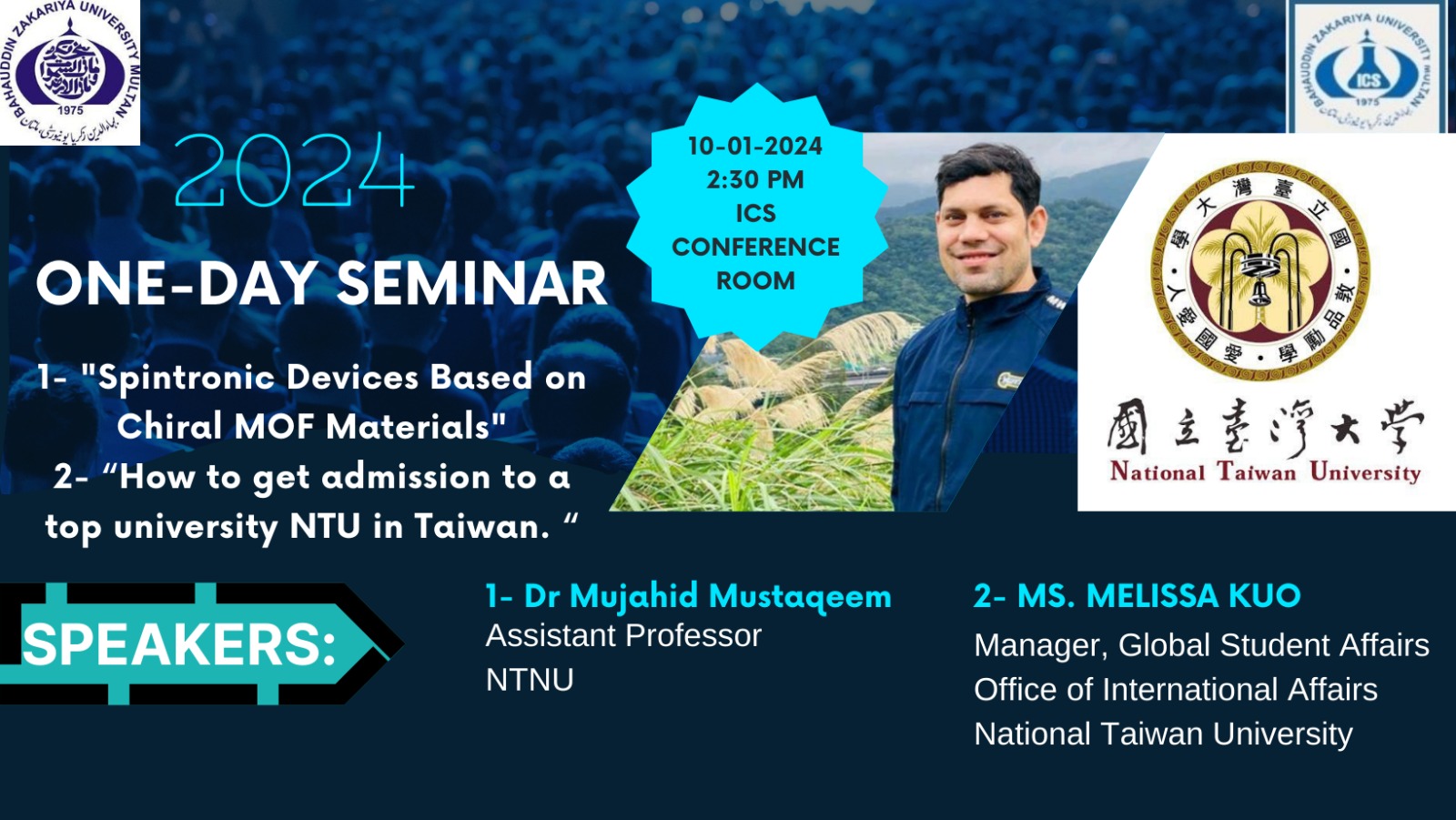
One Day Seminar
Invited Talk Title:
"Spintronic Devices Based on Chiral MOF Materials"
Online Talk Title :
How to get admission to a top university NTU in Taiwan.
Introduction of Dr Mujahid Mustaqeem:
Chiral metal-organic frameworks (CMOFs), a new
family of chiral hybrid materials, have piqued the interest of researchers due to
their structural variety and flexibility, order nanopores, cost-effectiveness, and
distinct chirality properties. We have developed CMOF [Sr(9,10-adc)(DMAc)2]n based
on achiral building blocks [(9,10-adc)] to fabricate spin-polarized flexible
detectors that give a detectivity (D*) as high as 1.83 × 10¹² jones, anisotropy
factor (gIph) is up to 0.38, photoresponsivity (Rph) and photogain (η) values of
CMOFs reach up to 6.0 × 10⁵ (A/W) and 1.8 × 10⁶, respectively superior to all
reported heterochiral MOF-based detectors. Additionally, we provided a different
strategy and developed spin-polarized LEDs based on chiral metal-organic framework
heterojunction and quantum dots (QDs) at room temperature without using
ferromagnetic connections or magnetic fields. The spin-polarized injected layer
was made of self-assembled monolayer (SAM)/Chiral-MOF ([Sr(9,10-adc)(DMAc)2]n)
film, which developed spin-polarized holes with spin orientation, impacting the
polarization and strength of circularly polarized electroluminescence (CP-EL). The
spin-QLED emitted CP-EL at a 12.24% efficiency, providing an ideal alternative for
generating new functionality for conventional QLEDs. Our approach is expected to
be very valuable, allowing us to provide a universal mechanism for generating
unrealized spin optoelectronic devices. These innovatively constructed devices
based on MOFs significantly contribute to the ongoing study of photonic devices